About Ahmedabad
| Background
Ahmedabad was the largest city in terms of area within the subcontinent before the arrival of the British and the setting of the Madras and Calcutta Presidency. Early 11th to 14th Century
The area around Ahmedabad was ruled by a Bhil king around the 11th century and was known as Ashapalli or Ashaval. The Solanki ruler of Patan, Karandev I, defeated the Bhil king in a war and established his kingdom, Karnavati at what is known as Maninagar today. The Solanki rule retained its hold until the 13th century, after which the reigns fell in the hands of the Vaghela dynasty of Dholka. Towards the end of the thirteenth century, all of Gujarat was captured by the Sultanate of Delhi and the Muzaffarid dynasty ruled here. |
|
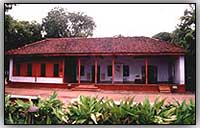 |
The Gandhi Ashram situated alongside the Sabarmati River, was the nerve center for the Indian Freedom movement. The beautiful ashram complex with it's shady trees offers a refuge from the loud streets of the city. There is a museum inside the Ashram complex. During the lifetime of Mahatma Gandhi it was known as Satyagraha Ashram. After Gandhiji's return from South Africa, he decided to settle in Ahmedabad. Mahatma Ganghi fondly known as Bapu lived here from 1917 until 1930. It is a peaceful, serene stretch on the banks of the Sabarmati river which is a national monument today...Read More |
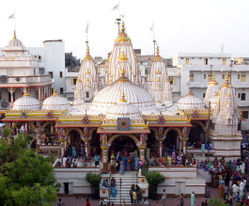 |
Swaminarayan Temple Kalupur This temple is the first temple of the Swaminarayan sect. Built around 1822. The temple is carved in Burmese teak, and every arch and bracket is painted with bright colors, a defining characteristic of Swaminarayan temples. Lord Swaminarayan himself installed idols of Shri Narnarayan Dev here. In the adjoining haveli, a special section for women, and an area where ceremonies and teaching sessions are held for women only. The Swaminarayan Temple is a splash of color in the midst of the city’s grey and is also the starting point for the Heritage Walk through the pols of the old city...Read More |
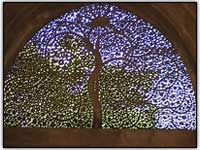 |
Sidi Saiyad Mosque This elegant mosque is noted for its twin windows of pierced stone, worked in style of a tree with palm leaves and curving tendrils. A superb and peerless example of delicate carving that transforms stone into filigree. It was constructed by Sidi Saiyad, a slave of Ahmed Shah, and has beautiful carved stone windows depicting the intricate intertwining of the branches of a tree. |
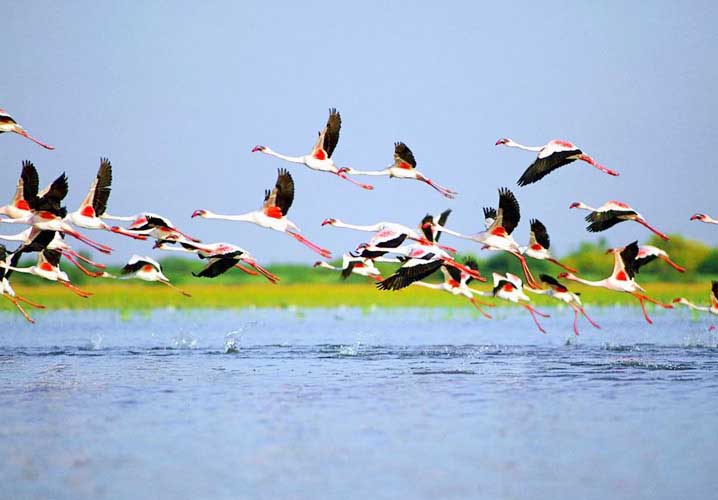 |
Nal Sarovar A black tailed godwit gracefully descends upon the tranquil water, flutters its wings and sails on. A small, brown and white wader with a slightly up curved bill, the bird has traveled 3500 kms from its nesting ground in Central Europe to spend the winter at Nalsarovar in Gujarat! Clouds upon clouds of more than 200 types of birds land in this lake having made an equally long journey to escape the harsh winter of their nesting areas. Here they find food and warmth. These migrant birds visit Nalsarovar every year from November to February...Read More . |